I’m back! I’d like to discuss the profound imbalance between consumption and creation that creates problems within my life and also appears to be a prevailing pattern in American society (although my tendency to project / analyze what are usually personal observations on a systematic level is likely worth its own discussion.) Consumption in this case is general – it could be food, ‘content,’ drugs or alcohol, even books or things that may be considered positive in relation to the aforementioned attention-flaying sorts.
I don’t think it’s about arriving at 50/50 parity in consumption and creation, it’s about getting somewhere other than 99.5 consumption / 0.5 creation. However, identifying opportunities to do both, i.e. cooking a meal and then eating it, may well be the ideal closed cycle in certain cases. It’s also about determining why consumption is occurring, deciding if that’s a reason I accept and want to sustain, and addressing that directly when it isn’t acceptable. I.e. driving towards numbness, avoiding thought, … essentially derealization and distraction are the main goals of my overconsumption and the symptoms and failures that have been described repeatedly on this blog flow naturally from that overconsumption. But this feedback loop is hard to get out of without conscious effort and practicing awareness of my emotions, goals and agency. The continuation of the cycle also produces feelings of judgment from the vestiges of self-awareness and the failure of action to rectify the situation, and yet even as I plunge into numbness to get away from those sensations, recognition of the pattern/harm remains and renders the activities fundamentally joyless. This prompts naïve intensification in service of finding those positive feelings I developed misleading correlations with. And creation – even just the creation of palpable emotions/serendipitous ideas/positive observation and engagement with the world around me – starts the moment I actively control/curb my overconsumption. This is part of the concept of context.
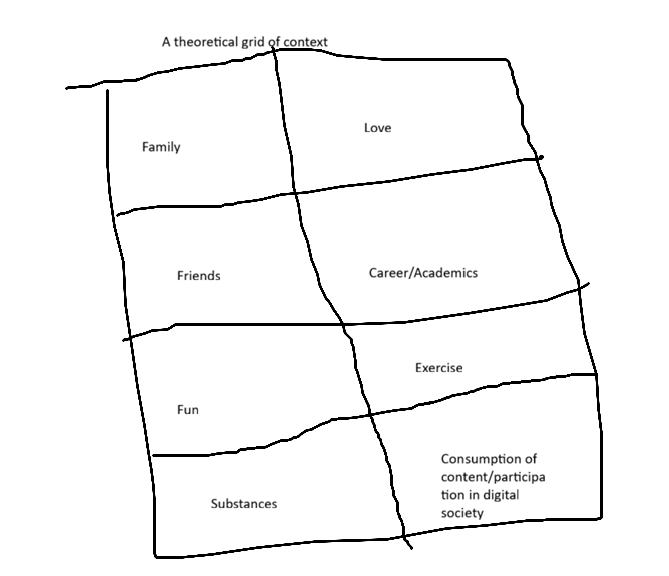
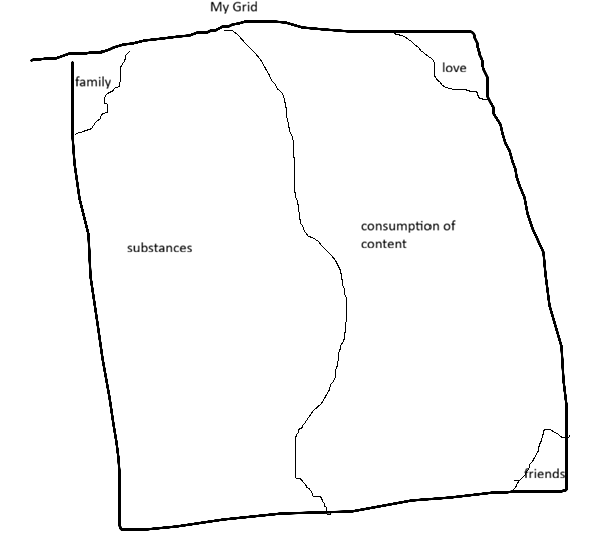
(Some super-high-tech visualizations of this idea and how things go wrong – note the fact that I indicate substances are somewhat equal in prominence to the others in a positive/normal world as a telling sign of how I might have arrived here.)
These things – those which threaten to take over one’s life – are addictive and designed/exist as such (https://www.bbc.com/news/articles/c747x7gz249o.) As I’ve described in other posts, if left unchecked and enabled by a series of conscious decisions a relatively normal grid can very quickly melt into the second one. The basic idea is that the various aspects of one’s life – including work – can be deeply satisfying when they take place in their proper context. When the rest of life is occurring ‘properly,’ those things that once took over your life can return to being sources of joy, if you so choose. But the challenge is being able to really stop, restructure, and allow the addictive behavior to entirely leave the system. I would add that some things are too potent, too addictive, too dangerous to be able to give even a single chance in a restructured life. Honestly alcohol consumed in non-social circumstances fits that description for me, although I wonder if even that qualifier (in non-social circumstances) serves just to excuse the continued consumption of the substance in the future. I think we know whether or not something fits into this category, whether we’d like to admit it or not.
And creation which proliferates to fill the newfound time could be anything, even the production of the sort of content of which we are personally attempting to moderate our consumption. There is a stark difference between producing a video as opposed to just watching them, even if it represents a continued enmeshment in the larger technofeudal net. I think the fear of imperfect work or vulnerability – both in terms of being seen personally or being known as imperfect – stops a lot of creation and stems from a life of overconsumption. It is easy to live in a tortured place where all one thinks is a reaction to ‘content’ and all one sees is end-products, manifestations of some modicum of effort by another. It’s like how when I look at someone else’s face I see a person, a visage, a rational fully-fledged whole, but when I look at myself I see acne, my nose, etc., an assortment of features to scrutinize individually.
To never go through the creative process is to deprive oneself of leniency, comprehension, imperfection; to exist in a world of perception where you are the only incomplete/deficient thing. This of course prompts resentment and disgust for others’ finished products, a critics’ mindset that one knows they have not earned because of their total lack of production or vulnerability. It also creates a life lived purely as an aesthetic/sensory experience, one that is superficial and contrary to introspection or immersion, giving the feeling of a loss of agency and serendipity.
One more note – consumption should not be diluted by doing multiple forms of it at once; when one watches a TV show while playing a game at the same time, neither experience is truly satisfying or as the creator intended. This is so normalized, however, that some TV execs are pushing for ‘second-screen’ content, which is necessarily more repetitive, less nuanced, and contrary to the production of ‘art’ as opposed to ‘content’ (also a force undermining the visual nature of the medium) (https://www.theguardian.com/tv-and-radio/2025/jan/17/not-second-screen-enough-is-netflix-deliberately-dumbing-down-tv-so-people-can-watch-while-scrolling) (also worth noting that things like soap operas have filled this niche forever, and it isn’t just a modern phenomenon (furthermore shows have always been repetitive around commercial breaks which have since disappeared; additionally the article quotes several people who refute the proliferation of the concept, but I still observe it in the shows that I watch; on a certain level I’m sticking with this point despite its weakness because I fear that ‘second-screen-ness’ will become normal in the future and I’d like to express that I dislike it.) The multi-content consumption is rather explicitly meant to distract, strip away the immediacy of experience and potential for personal feelings, and arrive at the numb dumbness I’m generally railing against.
 B Writes
Leave a comment